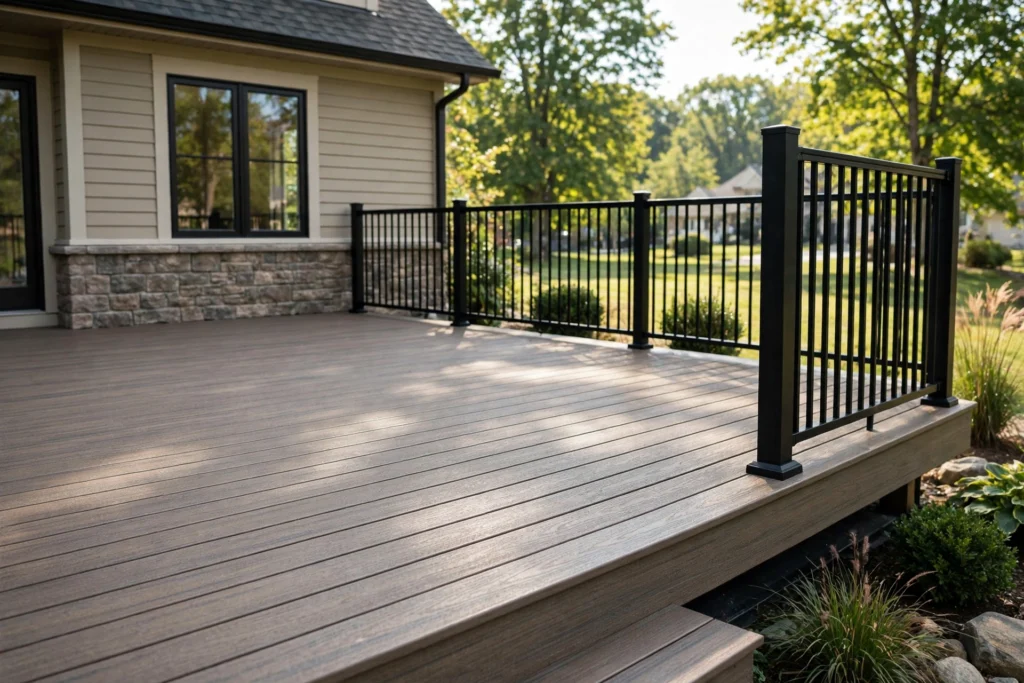
Composite decking is a popular option for homeowners who want the look of a finished deck without the same routine staining or sealing associated with many wood decks. Products vary by manufacturer, color, surface texture, board profile, warranty, and price, so choosing composite is only the first decision. The specific product matters, too.
Why homeowners consider composite
Composite boards are manufactured from a blend of materials and are designed for outdoor use. Many products offer coordinated colors, realistic wood-inspired patterns, and matching fascia or railing options. Routine care generally involves removing leaves and debris and cleaning the surface according to the manufacturer’s instructions.
Composite is not maintenance-free. It can collect dirt, pollen, and mildew under certain conditions, and boards can become hot in direct sunlight depending on color, exposure, and product. Scratches, stains, fading, and heat performance vary among product lines. Review current manufacturer guidance before choosing a board.
Composite versus wood
Composite usually has a higher upfront material cost than basic pressure-treated decking, though the total project cost depends on the entire design, framing, railing, stairs, and labor. Wood offers a natural appearance and may cost less initially, but it typically requires more regular surface maintenance. The best choice depends on your budget, desired appearance, and willingness to maintain the deck over time.
Details worth comparing
- Color and pattern: Look at full-size samples outdoors if possible. Colors can look different in shade and direct sun.
- Board profile: Some boards have grooved edges for hidden fasteners; others use face screws or different attachment systems.
- Slip and surface characteristics: Ask how the product performs in the conditions relevant to your property.
- Heat and sun exposure: Darker boards and areas with intense sun may feel hotter underfoot.
- Railing and trim: Coordinated components can create a more finished look but affect the budget.
- Warranty and care: Read the specific product’s warranty and cleaning requirements.
Planning a composite deck
A composite surface still relies on an appropriately designed and constructed support system. Framing, fastening, ventilation, drainage, and manufacturer-specific installation requirements all matter. Existing framing should not be assumed suitable for new boards without inspection, especially during a replacement project.
Talk through the options
If you are deciding between composite and wood, share your preferred look, how much maintenance you are comfortable with, and the approximate size of the deck. Request an estimate to start a conversation about materials and project scope.
Frequently asked questions
Does composite decking require no maintenance?
No. It generally avoids the recurring staining or sealing associated with many wood decks, but it still needs cleaning and care according to the manufacturer’s instructions.
Can composite boards go over an existing deck frame?
Possibly, but the frame must be inspected for condition, spacing, fastening compatibility, and other requirements. Replacing only the surface is not appropriate for every deck.
Is composite always more expensive than wood?
It often costs more upfront than pressure-treated wood, but final costs vary by product, design, railings, stairs, and installation requirements.